Spanish Water Dog: Breed Characteristics
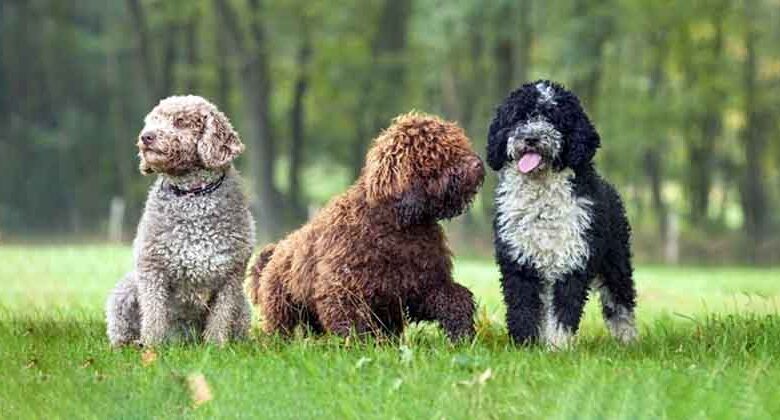
The Spanish Water Dog, in its various forms, has been a ubiquitous feature of Spanish farms for over a thousand years. This versatile working breed is capable of herding livestock, guarding people and property, and retrieving game with equal skill and determination.
The breed is highly intelligent and known for its cheerful disposition, making it an excellent family pet.
Occasionally used as a guard dog, owners should work with the dog from a young age to ensure its suitability for this role.
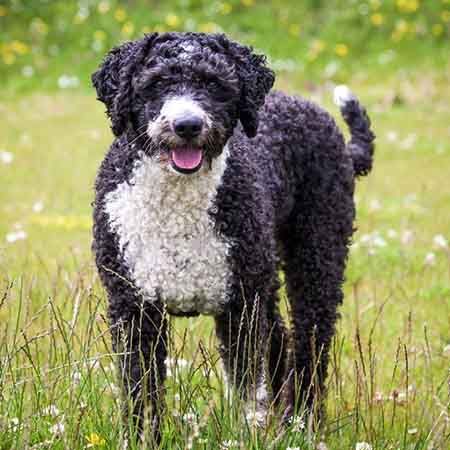 Spanish Water Dogs excel at almost any task and are a great choice for owners looking to compete in canine sports.
In addition, this breed often works alongside emergency services. They participate in search and rescue operations and are trained to detect drugs and explosives.
The breed’s distinctive curly coat points to its relation to other water dogs, especially the Irish Water Dog and Portuguese Water Dog. Its coat requires special care to maintain its waterproof qualities.
This is a highly energetic and determined breed. They need constant mental and physical stimulation to avoid boredom.
Health issues are fairly typical for this breed. The Kennel Club has joint and eye disease screening programs in place for all breeders. Despite these challenges, the average lifespan of a Spanish Water Dog is between 12 and 14 years.
History of the Spanish Water Dog
Like many ancient breeds, the history of the Spanish Water Dog is a subject of debate among canine historians. It has definitely existed for at least a thousand years, although many believe it may date back to the Roman Empire.
Oral history suggests it was first introduced to Spain by Turkish sheep merchants during the Middle Ages, who are known to have used dogs to herd their sheep.
Regardless of its origins, the breed was used for various tasks on Spanish farms in mountainous regions, primarily as a herding dog, but also for protecting sheep from predators and thieves.
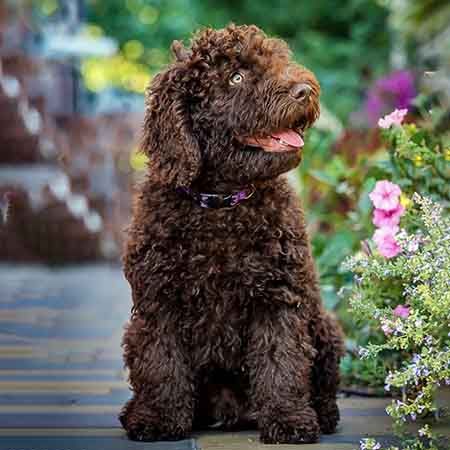 At one point in its history, it played a role in the development of the Irish Water Dog, another breed with an unusual curly coat.
The breed developed along three different lines in different regions of Spain, ultimately becoming the Cantabrian Water Dog, now a distinct breed.
The other two lines underwent extensive crossbreeding, resulting in the breed we know today as the Spanish Water Dog. Until relatively recently, it was confined to farm life, and only in the mid-1970s did two enthusiasts, Antonio Garcia Perez and Santiago Montesinos, begin building a breeding population to promote the breed.
It was officially recognized by the Fédération Cynologique Internationale (FCI) in 1999, when the current breed standard was finalized.
Breed Characteristics
Positive Traits:
- Spanish Water Dogs are loving and devoted pets and excellent family companions.
- They are intelligent and easy to train.
- They love water.
- They are not prone to separation anxiety.
- They are a good option for novice owners who have time for a dog.
Negative Traits:
- Spanish Water Dogs are prone to some health issues.
- Vet bills can be high.
- Puppies are expensive and often hard to find.
- They require a lot of daily exercise.
- They are not well-suited to apartment living.
- They can become bored easily.
- They can be noisy during play.
Interesting Facts About the Spanish Water Dog:
- Originally bred as herding dogs, they turned out to be exceptionally skilled at retrieving waterfowl.
- Spanish Water Dogs love water and children.
- They are excellent in all forms of water sports.
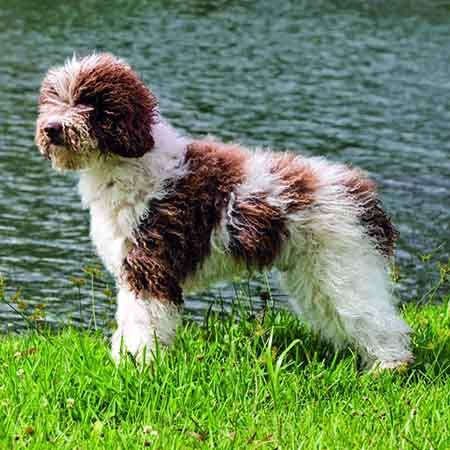 Appearance of the Breed
This is a medium-sized breed with well-defined proportions. The back is slightly longer than that of a typical dog, and it slopes downwards from the withers to the chest.
Size and Build
The breed has a somewhat rectangular outline, although this may be hidden by its thick coat. The head is relatively large, with a skull longer than the muzzle and flat between the ears.
Like the body, the head has straight lines, with the top of the muzzle and skull running parallel. The large nose matches the coat color or is darker, and the lips are firm with prominent corners.
The eyes are hazel or brown. The triangular ears are set at mid-height and lie flat against the sides of the skull.
The neck is short and broad, and the back is equally broad and strong, with a level topline. The tail was traditionally docked, but now that this practice is banned, some are born with naturally short tails.
Others have a full-length tail of medium thickness, hanging down to the hocks when relaxed. The chest is deep and broad, and the belly is slightly tucked.
The limbs are unusually straight for such a sporty breed and quite muscular.
Coat
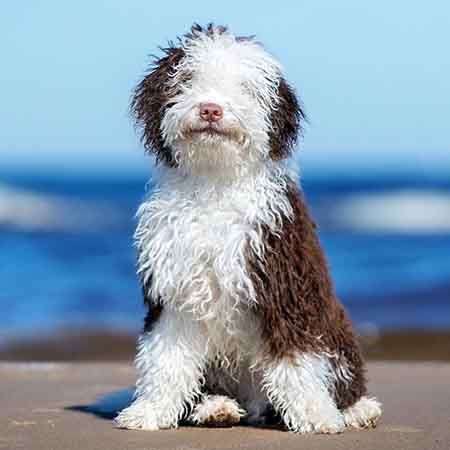
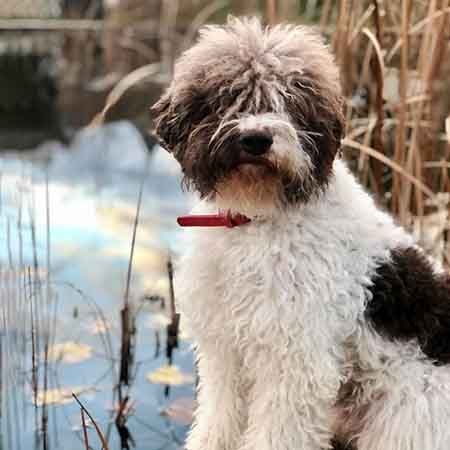
The coat of the Spanish Water Dog is unusual, being very curly and forming cords when allowed to grow. It can be solid or bicolor in one of the following combinations:
- White
- Black
- Chestnut
- Black and white
- Brown and white
Males stand at 44–50 cm at the withers and weigh 18–22 kg, while females stand 40–45 cm and weigh 14–18 kg.
 Temperament and Personality
The Spanish Water Dog is an exceptionally versatile breed. Despite its working heritage, it makes for a loyal and playful pet.
It is highly intelligent and loves to be involved in family activities. If excluded from family life, it can become shy or even sulky. Spanish Water Dogs live to work, whatever the job, and become lonely if they are not given one.
They can learn a wide variety of tasks with minimal training. With a bit of imagination, an owner can teach the dog to carry their shopping bag or find the TV remote.
Lack of socialization can sometimes result in a naturally shy adult dog becoming aggressive. If raised with children, they are generally patient, but like all dogs, they should not be left unsupervised with young children.
Spanish Water Dogs have an exceptional sense of smell, sight, and hearing. This makes them excellent working dogs, and they enjoy spending time outdoors.
They are sensitive by nature and form strong bonds with their owners and families. Known for their calm demeanor, they make excellent pets.
They are also known for their enthusiasm and willingness to please. However, puppies need proper socialization from an early age to ensure they grow up to be well-behaved and obedient dogs.
This breed is a great option for families with older children who know how to behave around dogs. Spanish Water Dogs tend to be aloof and suspicious of strangers, but they rarely show aggressive behavior towards them. They prefer to keep their distance until they get to know someone.
They are not the best choice for first-time owners who do not have time to train a dog, as the Spanish Water Dog requires clear direction. They need to understand what their owner expects of them, meaning their training should be consistent and fair from the beginning and throughout the dog’s life.
Training the Spanish Water Dog
They are highly trainable and quickly pick up new commands and tricks. However, like many smart breeds, they can be mischievous and may try to challenge their owner’s authority if they sense any hesitation.
For this reason, they are best suited to people with previous dog ownership experience who can calmly but firmly assert themselves when necessary.
The breed needs mental stimulation, which can be provided through activities such as agility or flyball.
Due to their natural wariness of strangers, socialization is especially important and should begin at an early age.
In adolescence, they can become fearful and reactive, so it is important to encourage good behavior and sociability during this period.
 Health
The breed is known to suffer from several common health issues. To gain approved breeder status, Spanish Water Dog breeders must have their dogs tested for hip dysplasia, goniodysgenesis, and progressive retinal atrophy, all of which are detailed below.
- Addison’s Disease: Most common in female puppies. This condition, also known as hypoadrenocorticism, occurs due to autoimmune damage to the adrenal glands, which produce essential hormones for maintaining normal bodily functions.
- Congenital Hypothyroidism: Spanish Water Dogs have a higher incidence of this condition, caused by a lack of thyroid peroxidase, which leads to low thyroid hormone levels.
- Goniodysgenesis: This eye condition can cause blindness due to improper drainage of fluid within the eye, resulting in increased intraocular pressure.
- Hip Dysplasia: A common hereditary cause of lameness, often found in the breed.
- Neuronal Axonal Dystrophy: A rare inherited condition that affects the spinal cord, leading to poor coordination and muscle weakness in young dogs.
- External Otitis: Their hairy ear canals are prone to blockages, which can lead to infections.
- Progressive Retinal Atrophy (PRA): A genetic eye disease leading to vision loss. Regular genetic testing is essential to prevent the spread of this condition within the breed.