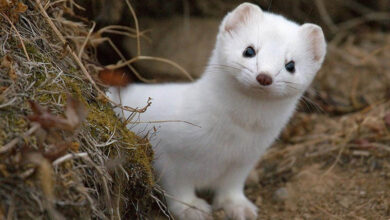
The fennec is a predatory marvel of the desert.

The Fennec Fox: The Most Eared Representative of the Local Fauna
The fennec fox, the smallest member of the local fauna, is adapted to life in harsh conditions that almost no one can get used to. Speed, agility, sensitivity, and family loyalty form the unique image of the desert’s nocturnal hunter.
 Description and Features of the Fennec
The light orange fennec reaches a height of 22 cm at the shoulder, with a body length of 65 ± 5 cm, half of which is a fluffy tail with a dark tip. The white fur on its belly and feet is dense, allowing the fennec to walk on the scorching desert sand without pain. Its thick, long fur protects its body from burns during the day and from freezing temperatures at night.
Interesting! Females are traditionally larger than males, with a length difference of up to 5 cm. An adult fennec weighs no more than 1.5 kilograms.
Scientists around the world have not reached a consensus on the fennec’s classification. Its resemblance to true foxes includes a pointed face, long whiskers for spatial orientation, a tail gland hidden under thick fur, and communication through barks. Those classifying it as a distinct species argue the following points:
- Its DNA consists of 32 pairs of chromosomes, which is 3 to 7 pairs fewer than that of true foxes.
- It has a round skull shape and a shorter nose.
- It leads a family-oriented lifestyle, which is unusual for foxes.
- Adult fennecs engage in social play, a trait only seen among young ones in other species.
- Its teeth, including canines, are smaller than those of other predators.
- Its pupils are round, whereas true foxes have vertically elongated pupils.
The main distinguishing feature of the fennec from other foxes is its ears. The largest in relation to body size among predators, the fennec’s ears can reach up to 15 cm. Its keen hearing allows it to detect the faintest sounds in the sand—using its ears, the fennec hunts. A network of blood vessels near the skin’s surface helps cool its body, enabling it to endure high temperatures.
Important! An aging fennec can be identified by its lighter color; by the end of its life, the fur turns white again.
Where Does the Fennec Live?
The fennec’s habitat is restricted to northern Africa and adjacent territories, spanning from Tunisia to Nigeria and from Morocco to the Arabian Peninsula. The highest concentration of the species is found in the Sahara, where conditions are favorable for the fennec’s survival.
Important! The shrinking habitat of the fennec is a result of human activities.
This member of the canine family is not dependent on water. A suitable nesting area can be far from water bodies, but there must be vegetation. Low shrubs and grass—unassuming desert flora—provide cover for this small creature. Dense thickets make it easy to dig a burrow and hide from predators. If it cannot find such a place, the fennec settles in the sand, digging numerous long tunnels that can intersect, forming secret passages and multiple exits. At night, it can dig a tunnel up to 6 meters long.
In case of danger, the fennec can hide in any burrow—the lower layers of the desert sands are crisscrossed with narrow tunnels. It is not afraid of encountering another family, as it is wary but not aggressive towards strangers.
Interesting! In northern regions of its habitat, fennecs tend to be larger. The closer the burrows are to the equator, the smaller the inhabitants.
 Social Structure
Fennecs are monogamous. Once paired, they form a family for life. Adults and offspring of various ages live in the same burrow. Often, the older young do not leave home but actively participate in raising new generations. Such a family can comprise over 10 individuals.
Fennecs mark their territory with waste. Males are the most active participants in this process. Males are ready to mate during January and February. During this time, they exhibit aggressive behavior towards rivals and mark their territory abundantly. However, the females are in heat for only a few days, during which pairs form.
The pregnancy of fennecs lasts for 53 days. During this time, they need to prepare a nest. A spacious burrow is lined with grass, leaves, their own fur, and even feathers. In the early spring months, the hidden tunnels of the Sahara fill with new inhabitants. A family can give birth to 2 to 6 pups, each weighing no more than 50 grams and measuring 14 cm in length, 4 cm of which is the tail. The mother does not leave the young for two weeks after birth until they open their eyes. During this period, the male provides food.
Interesting! In the first two weeks of the pups’ lives, the father cannot enter the burrow and leaves food nearby. The mother aggressively protects her offspring from any disturbances.
Three weeks later, the pups emerge for the first time. Their fur has not yet taken on a protective color and remains white for some time. At three months, the young stop nursing and begin to venture far from home. By six months, the young males are ready to have their own offspring, while females come into heat around nine months of age. However, not all leave their families; some stay with their parents to care for newborn pups, while others bring their mates into the family and settle together.
Close proximity to other families is not uncommon among fennecs. In extreme cases, they may even share a den. Males display aggression only during mating season, while females do so immediately after giving birth.
Interestingly, newborn fennecs have very small ears that initially curl up into tubes. The rapid growth of the ear flaps coincides with the opening of their eyes. Upon first venturing into the open, the young fennec is already equipped with large ears for its size.
Active play is enjoyable not only for the pups. Adult fennecs readily engage in play with the young, after which they rest together, curled up on the sand or in low grass, closely pressed against each other.
 Hunting and Feeding Habits of Fennecs
The fennec is a nocturnal predator. Like other foxes, it hunts alone; however, unlike its relatives, it does not pursue its prey but attacks immediately. Its keen hearing and ability to jump long distances allow it to save time on tracking. The developed musculature in its front legs is necessary for digging in the sand and extracting insects. Its eyesight is adapted for nighttime hunting.
Interesting! The extreme heat typical of the desert during the day is followed by near-freezing temperatures at sunset. Few species can live comfortably under such conditions, which is why the fennec’s diet is quite limited.
Along with animal food, the fennec also eats plants to obtain the necessary nutrients.
What Does the Fennec Eat?
The fennec’s diet includes:
- Grasshoppers – the main dish
- Rabbits and jerboas
- Steppe birds and their eggs
- Lizards
- Beetles, dragonflies, and other insects
- Carrion
- Watermelons, dates, and berries
- Roots of steppe and desert plants
This small predator can kill large prey. If it does not need to feed its family, the fennec buries the remains of its catch in the sand or soil. Its keen sense of smell will help locate the hidden reserves.
Similar to another desert inhabitant, the camel, the fennec can go without water for long periods. The moisture obtained from meat and plants is sufficient for its body. Evolution has equipped the fennec with adaptations: it has no sweat glands on its skin, and its urine is highly concentrated, allowing for very economical water usage.
Natural Enemies of Fennecs
Fennecs have few enemies. There are almost no large predators in the desert, and those whose diet includes the eared fox rarely manage to catch it.
- Humans: If a species’ population is rapidly declining, humans are certainly involved. Fennecs are caught in traps and snares, dogs are sent into their burrows, and nests are destroyed to take the pups. The fennec is valuable for:
- Its unique fur
- Tender meat
- Newborn pups that are sold to breeders.
In southern Morocco, the exploitation of wild territories has led to the fennec’s extinction. In many areas of its habitat, humans are building or paving roads, forcing desert foxes to leave their homes.
- Eagle Owl
- Desert Lynx
 Data regarding the danger posed by these predators is theoretical. There have been no eyewitness accounts of attacks. The fennec’s excellent hearing, sharp night vision, and strong front legs ensure safe hunting. In the face of a threat, it can bury itself in the sand, hide in secret tunnels, or simply leap away to a safe distance. The only real threat to the fennec comes from humans.
Population and Lifespan
Fennecs are listed in the Red Book with the designation of “Least Concern.” The number of wild individuals is unknown due to their secretive lifestyle. Around 300 fennecs are kept in zoos worldwide.
Data on the lifespan of fennecs in the wild is unconfirmed. It is believed to be around 7-10 years. In zoos, the fennec lives an average of 14 years, while a domesticated fennec can live up to 20 years.
The Domestic Fennec
Breeders affectionately call the fennec “fenek.” Kittens