Weasel – An Unusual Animal. Pros and Cons of Keeping a Weasel at Home

The word “weasel” carries associations of something kind, bright, and warm—like a mother’s embrace and the love of those close to us. However, this word also has another meaning, one that is diametrically opposed to the nature of a small but aggressive creature.
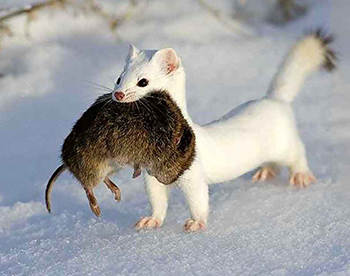 Appearance of the Weasel
A weasel is a carnivorous mammal, the smallest representative of the mustelid family, and in general features, it resembles a stoat or a ferret. Its specific characteristics include:
- A long, slender body measuring 11 to 21 cm for females and 16 to 26 cm for males, with a total weight of 30 to 250 grams;
- Short, powerful legs with sharp claws;
- A thick, long neck ending in a small head with a narrow snout;
- A small tail under which is a gland that secretes a strong-smelling substance used for marking territory;
- In summer, its fur is brown on top and white-yellow on the belly. In winter, its coat changes to pure white, providing excellent camouflage in the snow;
- The weasel moves by jumping and slithering, which, along with its elongated body and blunt snout, gives it a snake-like appearance;
- While generally silent, it can chirp when attacking or make soft sounds when communicating with its young;
- Its lifespan ranges from 1 to 5 years in the wild.
Habitat
Weasels can be found in Iraq, Iran, North Africa, China, Mongolia, Afghanistan, and many parts of Asia, excluding polar deserts. There is notable variation within the species: darker, smaller, short-tailed weasels inhabit Siberia and the Far East, while larger, lighter, long-tailed weasels live in Central and Southwest Asia, northern Africa, and southern Europe. In Russia, weasels are found almost everywhere except snow-covered mountains.
Diet
Weasels primarily feed on small rodents such as voles, gerbils, shrews, jerboas, moles, and rats. They also eat small reptiles, amphibians, snakes, and insects, and are particularly fond of raiding nests of non-predatory birds. A weasel typically consumes its prey on the spot but can carry prey weighing half of its body weight back to its den. In difficult times, it may feed on crustaceans or human food scraps.
Behavior
Despite its small size, the weasel has a fierce character—if it encounters a human, it will take a threatening stance and charge. Its bravery allows it to enter homes in search of food, often preying on poultry and domestic rodents.
Weasels are swift, agile, and dangerous, able to climb trees, quickly dig through burrows, and cross shallow bodies of water. They move in leaps of about 25 cm and can reach speeds of up to 50 km/h when escaping. They are highly energetic and can hunt during the day, though their primary hunting times are in the evening and at night.
Weasels don’t dig their own burrows but instead occupy several dens of their prey in hollow trees, under roots, or in rocky crevices. If food is plentiful, they store carcasses in one of their dens. However, weasels must also hide from larger predators such as wolves, foxes, raccoon dogs, badgers, martens, and various birds of prey. Despite their agility, which allows them to escape from sharp claws and teeth, they often fall victim to these predators.
 Keeping a Weasel as a Pet
Thanks to its excellent hunting abilities, weasels were once kept for pest control on farms, much like cats. However, as they also began to decimate poultry populations, they stopped being used for this purpose. Today, some exotic pet enthusiasts keep weasels, but they must be raised from a very young age. Adult weasels are unsuitable due to their wild and aggressive nature. Raising a weasel from a kit requires a long and challenging process of training, but with time, the weasel can become a friendly, playful, and communicative pet.